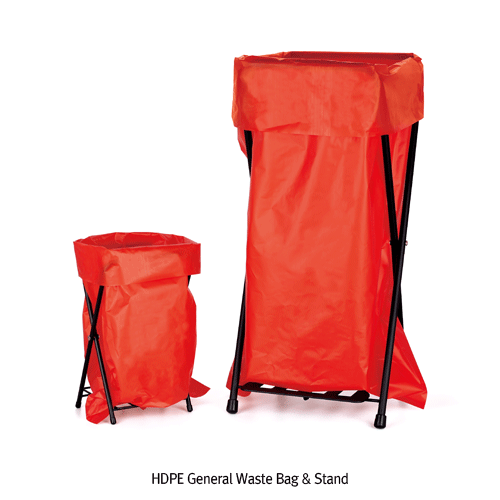
废物袋
Clean, organized waste handling is a basic requirement in laboratories, research facilities, healthcare environments, and technical workspaces. The right Waste Bags help separate routine waste from potentially hazardous material, support safer handling, and make day-to-day disposal workflows more efficient.
In this category, users can find laboratory waste bag solutions for general waste and biohazard applications, along with compatible stands that help keep collection points stable and easy to access. This makes the range relevant not only for disposal itself, but also for building a practical waste management setup around benches, preparation areas, and controlled work zones.

Waste bags for laboratory and controlled environments
Waste bags used in technical and laboratory settings are different from ordinary disposable liners because they are selected with workflow, material segregation, and handling safety in mind. Depending on the task, teams may need separate bag types for general waste and for material that should be visually identified as biohazard-related during collection and transfer.
This category includes both standard general waste bags and biohazard bag options in multiple sizes. It also includes supporting stands designed for biohazard bags, which can be useful where a free-standing collection point is needed near workstations or sample handling areas.
General waste and biohazard bags serve different purposes
One of the main selection points is the intended waste stream. General waste bags are typically used for non-hazardous disposable items generated during routine lab or facility operations, while biohazard-marked bags are used where clear identification of potentially contaminated waste is necessary according to site procedures.
For example, SciLab offers general waste bag options such as the SciLab SL.Bag3001.1 Bag, General Waste, 20 X 30 cm and the SciLab SL.Bag3003.1 Bag, General Waste, 50 X 75 cm. For biohazard applications, products in this category include models such as the DaiHan Y6.B003 Bag, Biohazard, 30 X 45 cm and the SciLab SL.Bag3004 Bag, PP Biohazard, 60 X 90 cm. The practical difference is not only labeling, but also how the bag fits into the site’s waste segregation process.
Why size matters in daily disposal workflows
Bag size has a direct impact on usability. Smaller formats can be more suitable for compact benches, localized collection, or lower waste volumes, while larger bags may be better for shared stations, high-throughput environments, or applications where bulkier disposable material is generated.
Within this range, available examples include compact 20 X 30 cm bags, mid-size 30 X 45 cm and 40 X 60 cm options, and larger 50 X 75 cm or 60 X 90 cm formats. Choosing the right dimensions helps reduce overfilling, improves handling during removal, and supports better fit with stands or collection frames used in the work area.
The role of bag stands in safer collection points
A waste bag is only one part of the disposal setup. In many laboratories, a bag stand helps keep the opening accessible, prevents the bag from collapsing, and creates a more consistent collection point for users. This can improve cleanliness and reduce unnecessary contact during disposal.
Examples in this category include the DaiHan SL.Sta7001 Stand, for Biohazard-bag, 20 X 30 cm, the DaiHan SL.Sta7004 Stand, for Biohazard-bag, 60 X 90 cm, and SciLab stand models such as SL.Sta7003 and SL.Sta7004. Matching stand size to bag size is a practical step that helps maintain stability and supports smoother waste handling in routine operation.
Representative brands in this category
This category features solutions from DaiHan and SciLab, both of which are relevant names for laboratory support equipment and consumables. Rather than treating all products as interchangeable, it is useful to compare them based on intended waste type, size, and whether the application requires a stand-based collection arrangement.
DaiHan products shown here focus strongly on biohazard bag and stand combinations, while SciLab includes both general waste bags and PP biohazard bag options, as well as compatible stands. This gives buyers flexibility when standardizing disposal points across different rooms or procedures.
How to choose the right waste bag setup
When selecting from this category, start with the waste stream definition used by your facility. If the disposal point is for routine non-hazardous items, a general waste bag may be appropriate. If the area handles potentially contaminated materials, biohazard-marked bags and a clearly designated stand may be more suitable for the process.
Next, check the required bag dimensions and available installation space. It is also worth considering whether your team needs stand-mounted disposal for better ergonomics and visibility. In broader lab workflows, users may also compare this range with related options such as sample bags for specimen handling or zipper bags for sealed storage and separation tasks.
Suitable applications across labs and technical facilities
Waste segregation is relevant in many environments beyond a single laboratory type. Research labs, quality control rooms, teaching labs, medical support areas, and industrial testing spaces may all require dedicated bag formats for safe and organized disposal at the point of use.
In practice, this category supports applications such as benchside waste collection, segregation of general disposables, temporary collection of biohazard-related waste, and deployment of stand-based disposal stations in controlled work areas. The combination of bag sizes and stand options makes it easier to adapt the setup to the physical layout and waste volume of each site.
Choosing with process consistency in mind
For many buyers, the goal is not just to purchase bags, but to create a disposal system that is easy to repeat across departments. Standardizing bag type, size, and stand compatibility can simplify replenishment, support user compliance, and make waste collection points easier to recognize during daily work.
If you are comparing options in this category, focus on three practical factors: waste classification, size requirement, and whether a stand is needed for stable placement. With those points defined, it becomes much easier to identify suitable products from DaiHan and SciLab for a cleaner and more consistent waste handling process.
-
-
-
-
-
-
-
-
-
-
-
-
-
-
-
-
-
-
-
-

-
-
-
-