


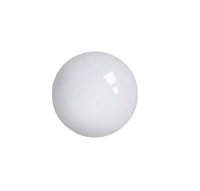
Standard ball
Reliable dimensional verification often depends on having a stable geometric reference. In inspection rooms, calibration workflows, and coordinate measurement setups, standard ball products are used as practical reference artifacts for checking accuracy, repeatability, and probe performance before critical measurements begin.
For users working with CMM systems, comparators, or precision mechanical inspection tools, this category brings together spherical reference elements in ceramic or carbide form. These items support routine setup, calibration-related checks, and controlled measurement tasks where ball diameter, roundness, surface quality, and mounting compatibility all matter.
Where standard balls are used in precision measurement
A standard ball is commonly selected when a measurement process needs a known spherical reference. Because a sphere provides a simple and repeatable geometry, it is useful for verifying touch probe behavior, assessing measurement consistency, and supporting alignment or qualification routines in metrology environments.
These products are especially relevant in CMM applications, where the reference ball may be mounted on a rod or fixture and used during setup or verification. In broader workshop inspection, spherical standards can also complement other reference tools such as setting rings or pin gauges, depending on the feature being checked.
Material and construction considerations
The products in this category include both ceramic standard balls and carbide measuring balls. Material choice affects how the ball behaves in daily use, including wear resistance, surface stability, and suitability for repeated contact in controlled measuring conditions.
Ceramic reference balls are often chosen where high roundness and stable reference geometry are important. Carbide versions are also widely used because of their hardness and durability, making them suitable for repeated handling and measurement-related tasks. In practice, selection should be guided by the inspection method, fixture design, and the precision level expected in the process.
Examples available in this category
This range includes reference items from INSIZE, with options suited to different metrology setups. A representative example is the INSIZE 4190-10D000 Ceramic Standard Ball, which provides a 10.000 mm reference diameter with fine roundness performance for precision applications where a high-quality spherical standard is required.
For CMM use, the INSIZE ISQ-16-025CE series is available in multiple thread options including M6, M8, M10, and M12, each supplied with a measuring rod. This type of configuration is useful when mounting compatibility is part of the selection process, since the thread standard and rod arrangement can influence how easily the ball integrates into an existing fixture or probing workflow.
The category also includes carbide measuring balls such as INSIZE 4172-8, 4172-6D5, 4172-6, 4172-5, 4172-4D5, and 4172-4, as well as the 4172-S19 set with multiple ball sizes. These are practical when users need different diameters for varied contact conditions, fixture designs, or measurement experiments across a wider inspection range.
How to choose the right standard ball
The first point to review is diameter. Ball size should match the measurement purpose, the probe or contact geometry involved, and the physical space available in the setup. A smaller ball may help with compact measurement arrangements, while a larger one may be preferred where contact stability or fixture visibility is more important.
The second factor is mounting style. In CMM environments, thread type and whether the product includes a measuring rod can be decisive. The ISQ series, for example, offers several thread options, which helps users align the reference ball with existing holders or machine accessories without unnecessary adaptation.
The third factor is the required level of geometric quality. When reviewing products, users typically compare diameter accuracy, roundness, and surface condition. These specifications matter because the reference artifact should not become the limiting factor in the inspection process. If your workflow also relies on other precision reference tools, it may be useful to review related categories such as angle gage blocks for angular setup tasks.
Why roundness and surface quality matter
In precision metrology, a spherical artifact is only as useful as its actual geometry. Roundness influences how consistently the ball can be contacted from different directions, while surface finish affects repeatability in probing and handling. A mirror-like surface and tightly controlled sphere geometry help reduce uncertainty during reference checks.
This is one reason ceramic CMM standard balls and carefully manufactured carbide balls are used in inspection environments rather than general-purpose balls. Even when the product is physically small, its geometric quality can have a direct effect on the confidence of the measurement routine built around it.
Role in a broader inspection ecosystem
Standard balls are rarely used in isolation. They are part of a wider metrology toolkit that may include reference rings, thread gauges, pin gauges, and other dimensional standards. Each tool supports a different type of feature, but all serve the same broader goal: maintaining confidence in measurement results and improving consistency across operators, machines, and batches.
For example, a spherical reference is well suited to probe qualification and spatial contact verification, while a dedicated pitch gage addresses thread identification tasks. Choosing the right standard depends on the geometry you need to verify, the measuring instrument in use, and the level of traceability expected in your quality process.
Practical buying guidance for industrial users
Before ordering, it is worth confirming the actual use case: calibration support, daily machine verification, fixture setup, or general inspection reference. From there, check ball material, nominal diameter, roundness, thread type if applicable, and whether a measuring rod is included. These practical details usually determine whether the product will fit smoothly into an established inspection workflow.
It is also helpful to think in terms of long-term usage rather than single-task convenience. A multi-size set such as the INSIZE 4172-S19 can be useful for labs or quality departments that handle varied components, while a dedicated ceramic or threaded CMM ball may be the better choice for a stable, repeatable setup on one machine.
Conclusion
When measurement reliability depends on a known spherical reference, choosing the right standard ball can make setup and verification work more consistent. Whether the requirement is a ceramic reference ball for precision CMM use or a carbide measuring ball for durable shopfloor support, the key is matching geometry, material, and mounting details to the real inspection task.
This category is intended to help industrial buyers compare suitable options with clearer context, so the selected reference artifact supports accurate measurement rather than adding uncertainty to it.
-
-
-
-
-
-
-
-
-
-
-
-
-
-
-
-
-
-
-
-
-
-
-
-