


Radius Gage
When a machined edge, fillet, groove, or formed profile must match a specified curvature, quick visual checking is often the most practical first step on the shop floor. Radius gage sets are widely used for this purpose because they help inspectors, toolmakers, and machinists compare internal and external radii directly against the workpiece without complex setup.
In precision manufacturing, these gauges are commonly used during setup, in-process inspection, and final verification. They are especially useful where repeatability matters but speed is also important, such as general machining, mold work, maintenance, and toolroom measurement tasks.
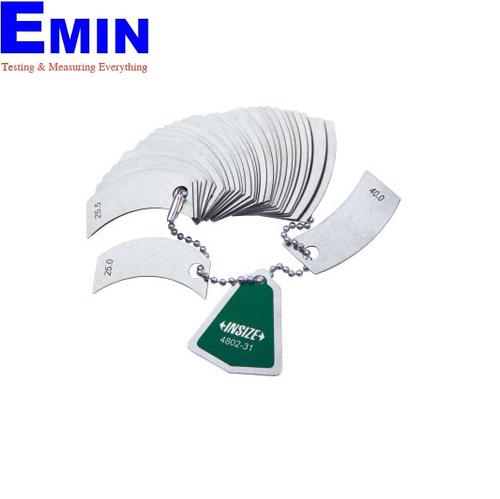
Where radius gauges fit in dimensional inspection
A radius gauge is designed to check whether a corner or contour matches a known radius. Each leaf in the set is shaped to a defined value, allowing the user to compare the profile of the gauge against the part. This makes it a practical tool for checking both concave and convex radii in metalworking and mechanical inspection.
Within a broader measurement workflow, radius gauges are often used alongside other comparison and reference tools. For example, threaded features may be checked with a pitch gage, while hole or bore verification may call for a pin gauge. Used together, these tools support faster decision-making before moving to more detailed measurement methods.
Common radius gauge types and profile styles
Radius gauge sets are typically selected by profile type, measuring range, and increment. In this category, you will find examples of ring and sleeve styles, which are intended for checking different profile orientations. Choosing the right style helps improve contact with the test surface and makes visual assessment easier.
Metric and inch-based sets are both common depending on drawing standards and production requirements. Some applications require fine step increments for small radii, while others need broader coverage across medium or larger curved features. For that reason, many users keep more than one set available to cover different jobs and tolerance expectations.
Examples available in this category
This range includes well-known options from MOORE & WRIGHT, with models such as the 204M and 206M for smaller metric radii, as well as 204MA and 206MA for larger metric ranges. Inch-based alternatives like the 204, 204A, 206, and 206A are also relevant where imperial drawings or legacy equipment remain in use.
For users comparing broader set composition, examples also include the NIIGATA SEIKI RG-26S and RG-34, as well as the MITUTOYO 186-106 Radius Gages Se. Fujitool is represented by compact fine-radius options such as the 178-112 set, which can be useful where small radii need to be checked in finer steps.
These product examples illustrate the main selection variables in this category: radius range, number of leaves, measurement system, and whether the gauge profile is intended for internal or external checking. Rather than focusing only on the number of pieces, it is usually better to match the set to the radii that actually appear in your drawings and process plans.
How to choose the right radius gauge
The first point to confirm is the measurement standard used in your workshop: metric, inch, or both. A mismatch between gauge units and drawing units can slow down inspection and increase the chance of interpretation errors. If your production environment handles mixed-origin parts, keeping separate sets for each system is often the more practical choice.
Next, look at the actual radius range required. Small-radius checking may need finer increments, while larger contours can often be covered with wider step values. The leaf count also matters because more leaves usually provide broader coverage, but a larger set is only worthwhile if those intermediate values are truly used in production.
It is also important to consider whether the workpiece geometry is easier to inspect with ring or sleeve profiles. In many cases, the difference affects how clearly the operator can seat the leaf against the surface and judge light gaps, contact lines, or fit quality. For quality control work, ease of use can be just as important as nominal range.
Typical applications in machining and toolrooms
Radius gauges are commonly used to inspect edge radii, fillets, formed contours, tool-ground shapes, and machined transitions between surfaces. They are particularly useful during setup verification, when operators want a quick confirmation before running a full batch. In maintenance or repair work, they can also help identify an unknown profile when documentation is incomplete.
In mold and die environments, radius checking supports profile consistency on cavities, inserts, and formed edges. In general fabrication or component manufacturing, the same tool can be used for incoming inspection, process checks, and final visual confirmation. While it is not a substitute for advanced contour measurement, it remains a highly efficient comparison method for routine inspection tasks.
Good practice for using a radius gauge
For reliable results, the workpiece surface should be clean and free from burrs, oil buildup, or damage that could affect contact. The selected leaf should be placed carefully against the radius and viewed under suitable lighting to judge how well it matches the contour. This simple approach is often enough to detect clear mismatch, undercutting, or excess material.
Operators should avoid forcing the leaf into position or assuming that a near match is acceptable without checking drawing tolerance requirements. Radius gauges are comparison tools, so interpretation still depends on the condition of the part and the user’s inspection method. Where tighter validation is needed, they can be combined with other reference tools such as a setting ring or other calibrated standards used in the measurement process.
Why this category is useful for industrial buyers
For B2B purchasing teams, selecting the right radius gauge category is less about buying a generic hand tool and more about supporting a repeatable inspection workflow. The right set can reduce setup time, improve communication between machining and QC teams, and make profile checking more consistent across shifts or production cells.
This category brings together practical options from established manufacturers including MOORE & WRIGHT, MITUTOYO, Niigata Seiki, and Fujitool. That makes it easier to compare radius coverage, leaf configuration, and measurement format based on actual application needs rather than relying only on product naming.
Final considerations before ordering
Before choosing a set, review your drawing standards, the most common radius values in production, and whether operators need internal, external, or mixed profile checking. It is also worth considering whether a compact fine-step set or a broader general-purpose range will deliver better day-to-day value in your inspection workflow.
If you are building out a complete dimensional inspection toolkit, a well-matched radius gage set can be a practical addition to other mechanical gauging tools. With the right range and profile style, it becomes a fast, dependable solution for checking curved features across machining, maintenance, and quality control applications.
-
-
-
-
-
-
-
-
-
-
-
-
-
-
-
-
-
-
-
-
-
-
-
-